

Buildroot 2010.08 released!

Buildroot logoOn the last day of August, just in time, the 2010.08 version of Buildroot has been released. For the record, Buildroot is an easy-to-use embedded Linux build system: it can build your toolchain, your root filesystem with all its components (Busybox, libraries, applications, etc.), your kernel and your bootloaders, or any combination of these components.

Amongst the interesting changes in this version :

  • Complete rewrite of the bootloader build code. It contained a lot of legacy, unused and unclear stuff, it is now much easier to use and extend. We’ve removed support for Yaboot and added support for the new Barebox bootloader, and all the code to support AT91Bootstrap, AT91DataFlashBoot, U-Boot, Grub and Grub 2 has been rewritten.
  • Complete rewrite of the Linux kernel build code. It was also complicated to use, with an horribly complicated kernel version selection mechanism, the new code is much easier to configure and use.
  • The configuration file .config is now located in the out-of-tree directory when the O= option is used. So typically, for an out-of-tree build (which are very convenient when using the same Buildroot source tree for different projects/tests), you could do : mkdir ~/myoutput ; make O=~/myoutput menuconfig ; make O=~/myoutput
  • Support for building NPTL toolchains with uClibc, using the latest uClibc snapshots.
  • Support for the gconfig Gtk-based configurator, in addition to the already available menuconfig and xconfig
  • A particular effort has been put on fixing many of the bugs in our Bugzilla, improving robustness thanks to automated random builds, and converting even more packages to the generic and autotools infrastructure
  • Various things have also been deprecated: support for the CRIS, IA64, Sparc64 and Alpha architectures, support for Gtk over DirectFB (which is at the moment not supported upstream), Java support (no maintainer has volunteered to maintain this in Buildroot)
  • Many components have been bumped to newer versions
  • The shared configuration cache, which allowed to speed up the configuration of different packages, has been disabled by default, since it was causing a lot of problems with certain package configurations

I’ve again contributed to a significant portion of this release, being the author of the bootloader build code cleanup, the Linux kernel build code rewrite, leading an effort to reduce the number of outstanding bugs in our Bugzilla and many other little things. The contributors for this release are shown below :

   175  Peter Korsgaard
   168  Thomas Petazzoni
    38  Gustavo Zacarias
    18  cmchao
     8  Luca Ceresoli
     7  Paul Jones
     6  Lionel Landwerlin
     6  Malte Starostik
     5  Yann E. MORIN
     3  Julien Boibessot
     3  Khem Raj
     2  Dmytro Milinevskyy
     2  Francois Perrad
     2  Nick Leverton
     2  Peter Huewe
     2  Stanislav Bogatyrev
     1  Baruch Siach
     1  Bjørn Forsman
     1  Daniel Hobi
     1  Darcy Watkins
     1  Darius Augulis
     1  H Hartley Sweeten
     1  Karl Krach
     1  Kelvin Cheung
     1  Ossy
     1  Sagaert Johan
     1  Simon Pasch
     1  Slava Zanko
     1  Thiago A. Correa
     1  Will Wagner
     1  Yegor Yefremov

For the next release, there are already a few things in the pipeline :

  • Cleanup of all the board support code in Buildroot, in order to cleanly add support for more boards like BeagleBoard, Qemu boards, Calao boards, etc. We’ll use the new minimal defconfig mechanism used by the kernel. I’ve already started working on this
  • Cleanup of the package download process, to support Git and SVN download. The code has already been written by Maxime Petazzoni, reviewed on the list, so I expect it to be included fairly soon
  • Rewrite of libtool handling code, to remove some of our ugly libtool hacks. The code is currently being worked on by Lionel Landwerlin
  • Support for compiling toolchain using Crosstool-NG as a backend. The code is currently being finalized by Yann E. Morin, the author of Crosstool-NG
  • Further work on package uninstallation, clean partial rebuild. Some work has been started by Lionel Landwerlin, but it needs some discussion
  • Continue the conversion of packages to the generic and autotools infrastructures
  • I have also a ton of other things on my TODO-list : rework gdb/gdbserver support with external toolchains, rework the configuration of IPv6/RPC/locale/etc. with external toolchains, set up a Wiki-based Buildroot website with tutorials and better documentation, clean up the toolchain build process, reduce the number of “enhancement” bugs waiting in our Bugzilla, etc.

As Peter Korsgaard, Buildroot maintainer, said in the 2010.08 announcement: The next release is going to be 2010.11. Expect the first release candidate in late October and the final release at the end of November..

It is worth noting that we will be having a Buildroot Developer Day, on Friday 29th October, right after Embedded Linux Conference Europe. At least Peter Korsgaard, Lionel Landwerlin, Yann E. Morin and myself should be there.
Faster boot: starting Linux directly from AT91bootstrap

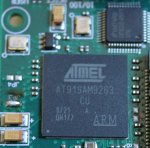
Reducing start-up time looks like one of the most discussed topics nowadays, for both embedded and desktop systems. Typically, the boot process consists of three steps: AT91SAM9263 CPU

  • First-stage bootloader
  • Second-stage bootloader
  • Linux kernel

The first-stage bootloader is often a tiny piece of code whose sole purpose is to bring the hardware in a state where it is able to execute more elaborate programs. On our testing board (CALAO TNY-A9260), it’s a piece of code the CPU stores in internal SRAM and its size is limited to 4Kib, which is a very small amount of space indeed. The second-stage bootloader often provides more advanced features, like downloading the kernel from the network, looking at the contents of the memory, and so on. On our board, this second-stage bootloader is the famous U-Boot.

One way of achieving a faster boot is to simply bypass the second-stage bootloader, and directly boot Linux from the first-stage bootloader. This first-stage bootloader here is AT91bootstrap, which is an open-source bootloader developed by Atmel for their AT91 ARM-based SoCs. While this approach is somewhat static, it’s suitable for production use when the needs are simple (like simply loading a kernel from NAND flash and booting it), and allows to effectively reduce the boot time by not loading U-Boot at all. On our testing board, that saves about 2s.

As we have the source, it’s rather easy to modify AT91bootstrap to suit our needs. To make things easier, we’ll boot using an existing U-Boot uImage. The only requirement is that it should be an uncompressed uImage, like the one automatically generated by make uImage when building the kernel (there’s not much point using such compressed uImage files on ARM anyway, as it is possible to build self-extractible compressed kernels on this platform).

Looking at the (shortened) main.c, the code that actually boots the kernel looks like this:

int main(void)
{
/* ================== 1st step: Hardware Initialization ================= */
/* Performs the hardware initialization */
hw_init();

/* Load from Nandflash in RAM */
load_nandflash(IMG_ADDRESS, IMG_SIZE, JUMP_ADDR);

/* Jump to the Image Address */
return JUMP_ADDR;
}

In the original source code, load_nandflash actually loads the second-stage bootloader, and then jumps directly to JUMP_ADDR (this value can be found in U-Boot as TEXT_BASE, in the board-specific file config.mk. This is the base address from which the program will be executed). Now, if we want to load the kernel directly instead of a second-level bootloader, we need to know a handful of values:

  • the kernel image address (we will reuse IMG_ADDRESS here, but one could
    imagine reading the actual image address from a fixed location in NAND)
  • the kernel size
  • the kernel load address
  • the kernel entry point

The last three values can be extracted from the uImage header. We will not hard-code the kernel size as it was previously the case (using IMG_SIZE), as this would lead to set a maximum size for the image and would force us to copy more data than necessary. All those values are stored as 32 bits bigendian in the header. Looking at the struct image_header declaration from image.h in the uboot-mkimage sources, we can see that the header structure is like this:

typedef struct image_header {
uint32_t    ih_magic;    /* Image Header Magic Number    */
uint32_t    ih_hcrc;    /* Image Header CRC Checksum    */
uint32_t    ih_time;    /* Image Creation Timestamp    */
uint32_t    ih_size;    /* Image Data Size        */
uint32_t    ih_load;    /* Data     Load  Address        */
uint32_t    ih_ep;        /* Entry Point Address        */
uint32_t    ih_dcrc;    /* Image Data CRC Checksum    */
uint8_t        ih_os;        /* Operating System        */
uint8_t        ih_arch;    /* CPU architecture        */
uint8_t        ih_type;    /* Image Type            */
uint8_t        ih_comp;    /* Compression Type        */
uint8_t        ih_name[IH_NMLEN];    /* Image Name        */
} image_header_t;

It’s quite easy to determine where the values we’re looking for actually are in the uImage header.

  • ih_size is the fourth member, hence we can find it at offset 12
  • ih_load and ih_ep are right after ih_size, and therefore can be found at offset 16 and 20.

A first call to load_nandflash is necessary to get those values. As the data we need are contained within the first 32 bytes, that’s all we need to load at first. However, some space is required in memory to actually store the data. The first-stage bootloader is running in internal SRAM, so we can pick any location we want in SDRAM. For the sake of simplicity, we’ll choose PHYS_SDRAM_BASEhere, which we define to the base address of the on-board SDRAM in the CPU address space. Then, a second call will be necessary to load the entire kernel image at the right load address.

Then all we need to do is:

#define be32_to_cpu(a) ((a)[0] << 24 | (a)[1] << 16 | (a)[2] << 8 | (a)[3])
#define PHYS_SDRAM_BASE 0x20000000

int main(void)
{
unsigned char *tmp;
unsigned long jump_addr;
unsigned long load_addr;
unsigned long size;

hw_init();

load_nandflash(IMG_ADDRESS, 0x20, PHYS_SDRAM_BASE);

/* Setup tmp so that we can read the kernel size */
tmp = PHYS_SDRAM_BASE + 12;
size = be32_to_cpu(tmp);

/* Now, load address */
tmp += 4;
load_addr = be32_to_cpu(tmp);

/* And finally, entry point */
tmp += 4;
jump_addr = be32_to_cpu(tmp);

/* Load the actual kernel */
load_nandflash(IMG_ADDRESS, size, load_addr - 0x40);

return jump_addr;
}

Note that the second call to load_nandflash could in theory be replaced by:

load_nandflash(IMG_ADDRESS + 0x40, size + 0x40, load_addr);

However, this will not work. What happens is that load_nandflash starts reading at an address aligned on a page boundary, so even when passing IMG_ADDRESS+0x40 as a first argument, reading will start at IMG_ADDRESS, leading to a failure (writes have to aligned on a page boundary, so it is safe to assume that IMG_ADDRESS is actually correctly aligned).

The above piece of code will silently fail if anything goes wrong, and does no checking at all – indeed, the binary size is very limited and we can’t afford to put more code than what is strictly necessary to boot the kernel.