
 From the 13th to 16th of July in Rome, Italy, 130 Linux Kernel developers specialized in networking gathered at the Netdev 0x1a Conference, accompanied by 50 people attending remotely.
As someone who works a lot on Network drivers for Embedded Linux devices, I attended the event as well as the Netconf conference, a smaller conference that took place on the first day of the event and gathered Network Maintainers and Contributors to discuss ongoing topics in the Linux Kernel Networking ecosystem.
Netconf
For 2 years now, Bootlin has been contributing to the review effort on the Netdev mailing list. To that effect, I’ve been allocated half a day per week of my work time to help with code/patch reviews, and as a result my involvement in the community I’ve received an invitation to attend Netconf with a handful of other contributors and the Networking maintainers.
The topics were brought directly by the various participants, and ranged from process and testing topics to more technical discussions on TCP upper encapsulation, XDP metadata and timestamping. I took the opportunity to discuss some low-level topics that were raised multiple times on mailing lists, that is the loopback and link testing using PRBS patterns. This eventually was discussed in the hallway track around a much-needed cold drink with some active contributors in this area.
Netdev – Timestamping
Netdev talks cover a very broad range of topics, from driver-level discussions to high-level design and orchestration within a datacenter network. As there were more than 30 hours worth of talks, we’ll only focus on low-level and process-oriented discussions for this summary, most of which occurred on Tuesday.
Tuesday morning was focusing on driver-oriented sessions, starting with a very interesting talk by Maciek Machnikowski on representing the time uncertainty for packet timestamping. Let’s deep dive into it.
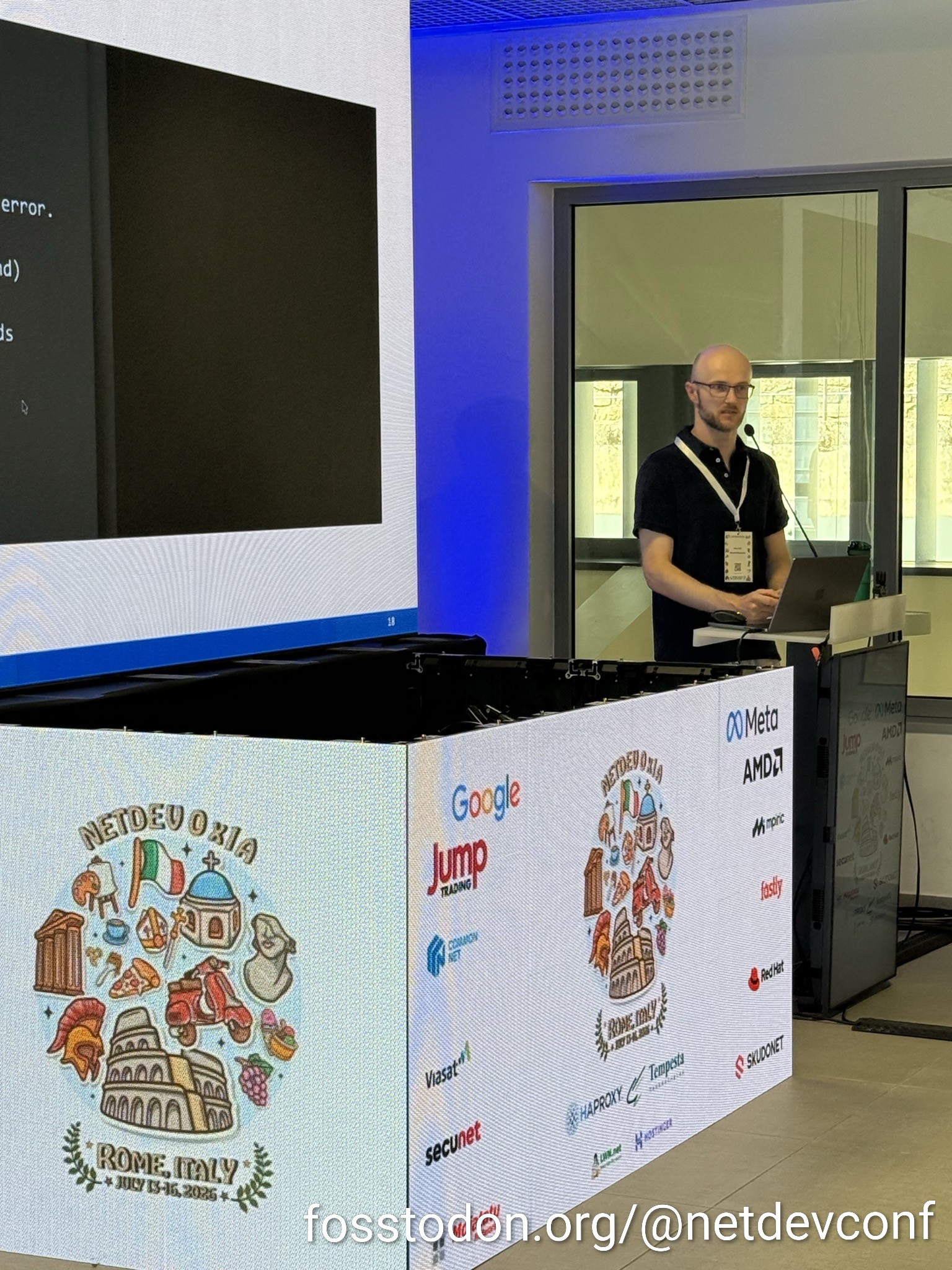
It builds on the principle that for a while, the focus has been on getting the most precise timestamping units possible, capable of producing timestamps in the nanoseconds range, while the accuracy factor was being ignored.
As explained by Maciek, having nanosecond-precision in the generated timestamp only matters if your clock is accurate enough not to drift between re-synchronizations (which he called anchors), and if we account for the uncertainty factor down at the link and network level.
Maciek therefore proposed an extended representation of timestamps, that includes an “error bar” that takes into account the time since the last anchor, the clock accuracy as well as hardware factors. This is very valuable when debugging distributed systems, as event ordering depends not only on the time of the measured events, but also on how accurate the timestamps are. Two events may appear to be only a few nanoseconds apart and in a given order, but if their accuracy is only in the microseconds order, then no actual ordering can be deduced from the timestamps. As the accuracy depends on how long it has been since the clock was last synchronized and how fast it can drift, Maciek presented a dedicated userspace tool to compute and expose these timestamps and their accuracy.
Netdev – Drivers workshop
This talk was followed by the Driver Workshop animated by Paolo Abeni, one of the maintainers of the networking subsystem.
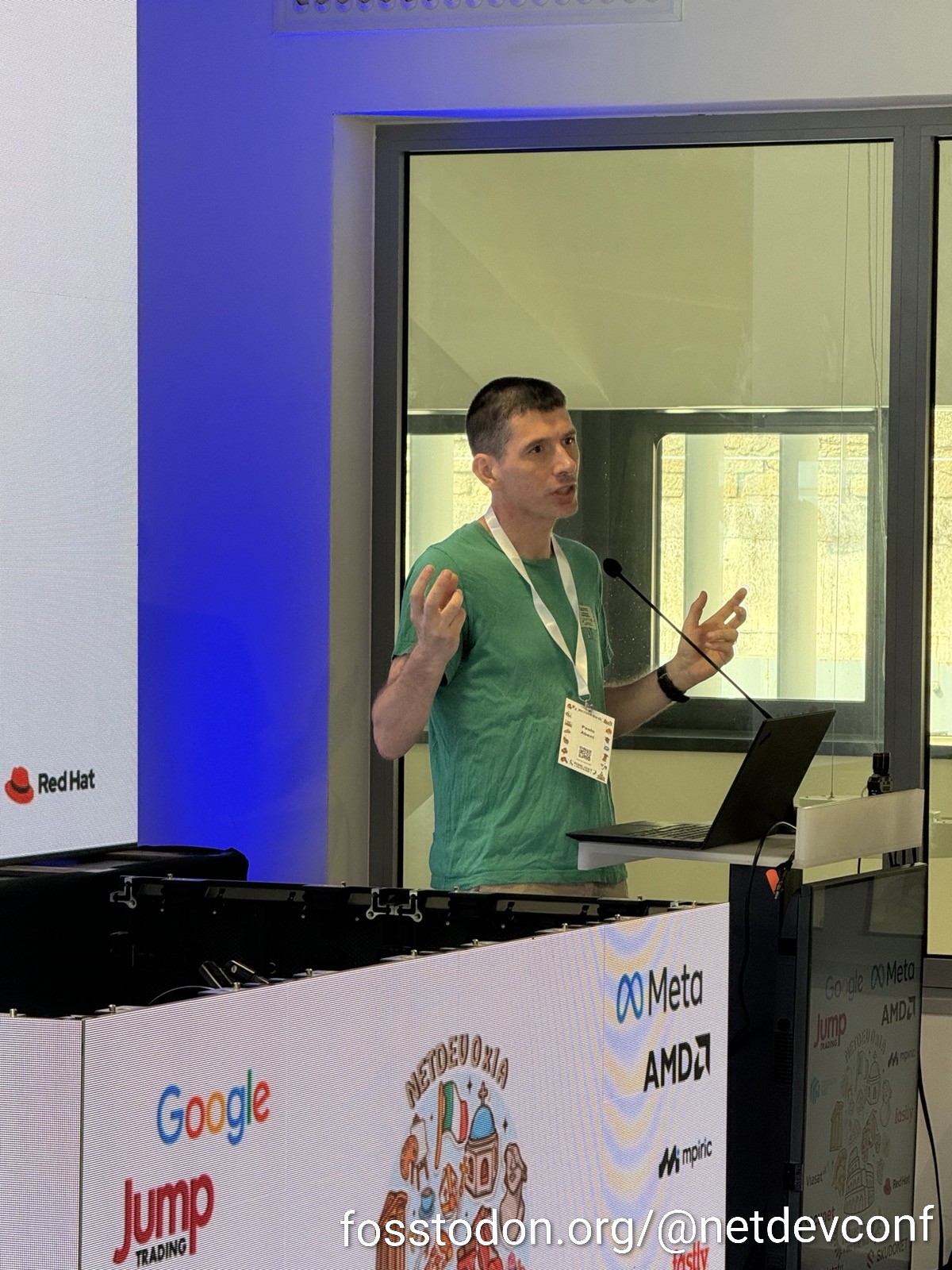
Paolo discussed the current challenges faced by contributors and maintainers to get a driver upstream, as AI tooling like sashiko tend to increase the revision count of new drivers, some getting up to 43 revisions before being accepted. He mentioned that submitters should get accustomed to having to deal with AI reviews, and can be proactive by replying themselves to AI comments, to avoid maintainers having to triage sashiko reports themselves. Cross-company review was mentionned as an important but easy step to ease overall maintainance on the netdev list.
The workshop was concluded by 2 other talks, Sridhar Samudrala And Jayaprakash Shanmugam from Intel presented the architecture of their new driver family for recent networking IPs, called ixd and idpf, then David Ertman presented how they’re using the auxiliary bus infrastructure to provide resource sharing between interfaces on idpf and ixd.
Netdev – Process and maintainance
On Tuesday afternoon, the discussions started with a panel session where Jakub Kicinski, Paolo Abeni and Eric Dumazet participated in a Q&A with the audience, as Network Maintainers. As one can expect, discussions were heavily oriented towards AI tooling and its impact on the contribution process. As the amount of new contributors grow, and with the wide adoption of LLMs to assist in development, the mailing list traffic is increasing substantially. The networking community is therefore leaning towards a score-based approach to select what’s the next patch series to review. The score is computed based on code quality as well as the author’s participation on the review effort. The author’s employer score is also taken into account, to encourage companies to help in the review effort as well.
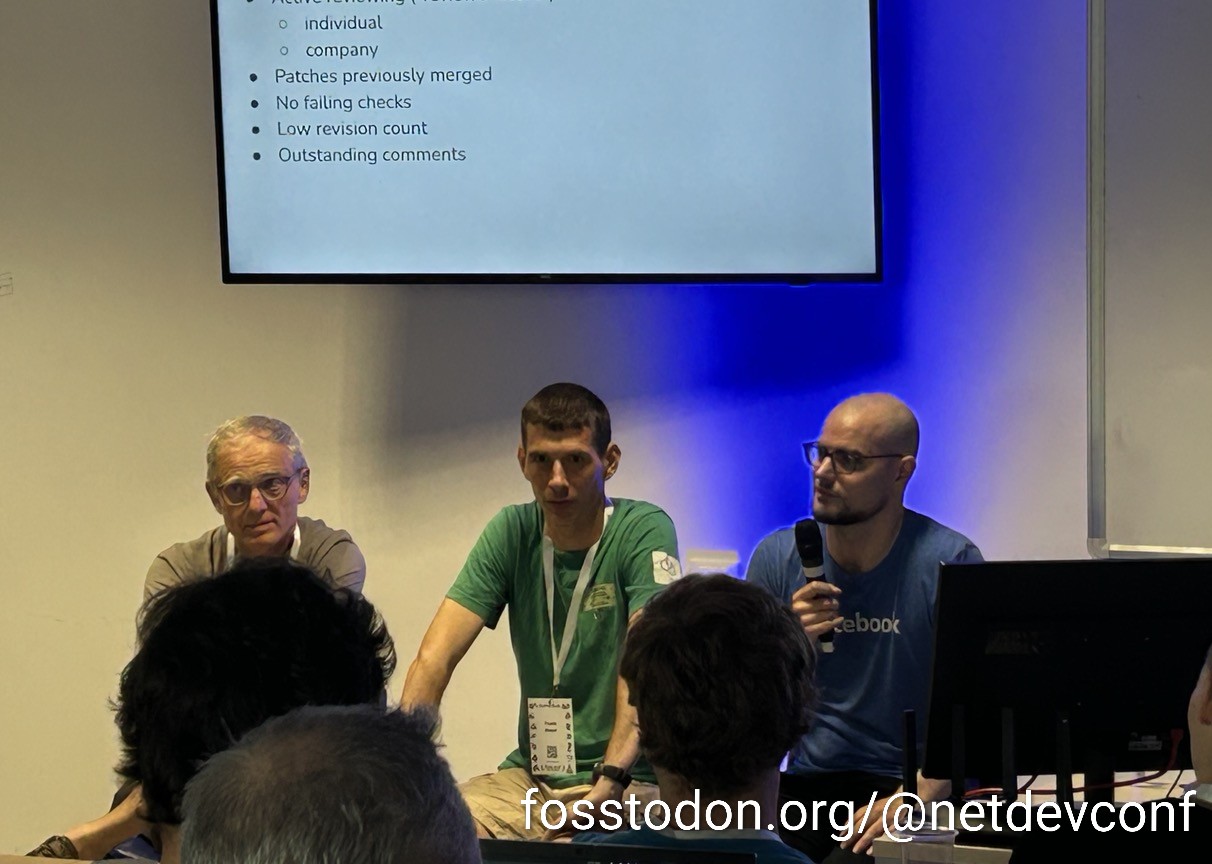
Much more topics were discussed, the materials for the various talks should be available on the Netdev schedule soon.
What’s next
At the end of the last day, our main hosts Jamal and P.J. announced their desire to have the next Netdev event in Zanzibar, with the hope of having more and more technical conferences in Africa. In the meantime, the next big event for kernel networking enthusiasts will be in Prague this fall, for the Linux Plumbers Conference.
I’ll conclude by thanking Bootlin once again for sending me there, and the Network maintainers for inviting me to Netconf, it was truly a blast !
